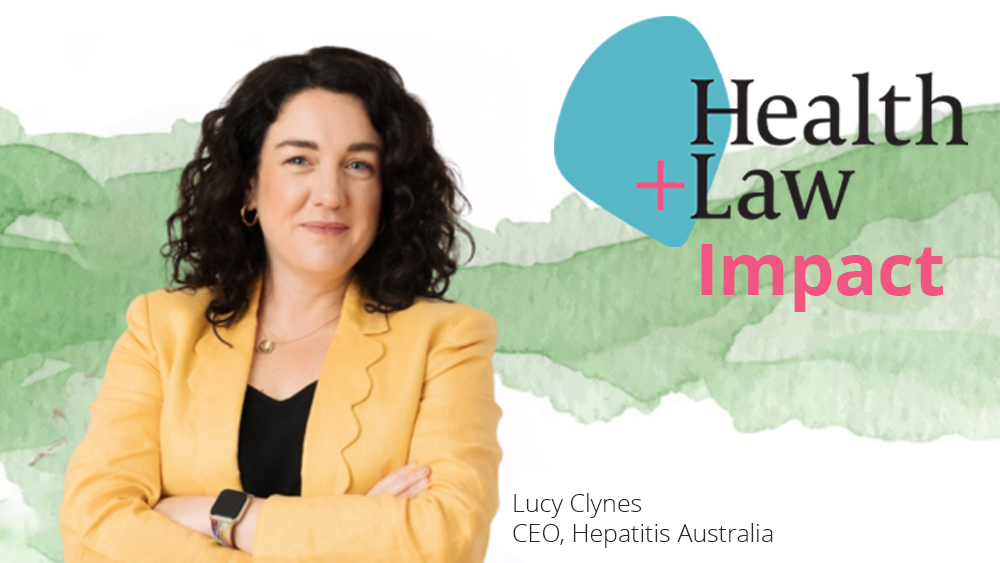
Around three quarters of people living with chronic hepatitis B in Australia are not receiving the recommended, guideline-based care for their condition. ‘People are not getting regular liver scans, they’re not getting regular viral load checks’, says Hepatitis Australia’s CEO Lucy Clynes. ‘They’re probably not getting medication at the rate that they need to be taking it. It’s enormous.’
Hepatitis Australia is running a national awareness campaign targeting people in the communities most affected by hepatitis B. As the national peak body for the community response to viral hepatitis, Hepatitis Australia advocates on behalf of the nearly 300,000 people living with hepatitis B and hepatitis C across the country. ‘We do a lot of work around awareness raising for people living with hepatitis B, just to make it safe for people to come forward to talk about what care they need’, Lucy explains. The campaign has been designed to appear in pharmacies and GP waiting rooms, and to gently encourage people to seek information and potentially get access to care where they might have avoided it; a gentle encouragement, like ‘you might be at risk of hepatitis B and you’re allowed to talk about it before testing, treatment, scans, whatever you need.’
Somewhere between 220,000 and 226,000 people are living with chronic hepatitis B in Australia, which accounts for roughly 0.82% to 0.9% of the population – and makes hepatitis B the most prevalent of all blood-borne viruses in the country by far. ‘A third of people with hepatitis are undiagnosed, so some of them just don’t know that they are living with hepatitis B,’ Lucy notes. And while efforts like the current awareness campaign can help address these quite staggering unaddressed medical needs, for many in the hepatitis B-affected community, the obstacles start well before they meet with a GP or other healthcare professional.
‘The communities impacted by hepatitis B are incredibly marginalised. Often very stigmatised’, explains Lucy.
Alongside its member organisations – community-based hepatitis organisations in every state and territory – Hepatitis Australia has increasingly recognised, and sought to address, these larger social and structural barriers that shape affected people’s lives, including whether they can access the most rudimentary, guideline-based care.
As the national peak’s research activities with Health+Law – with whom it is a core partner – have shown, these barriers include some very significant legal ones. Mandatory health disclosures linked to training and education, temporary and uncertain migration status, workplace disclosure obligations – these are among the legal issues and circumstances that often shape whether people can seek health care at all.
Lucy is quite clear that the challenges faced by people living with hepatitis B extend far beyond the health system: ‘The socio-legal needs of people with hepatitis B are enormous’, she says.
But there is scarce little information about how the law affects people living with hepatitis B. When Hepatitis Australia co-founded Health+Law – with the National Association of People with HIV Australia (NAPWHA), the peak national body representing people living with HIV, and with academics across UNSW, UTS and QUT as partners – there was essentially no research at all. Community organisations certainly understood many of the legal challenges, both anecdotally and from the lived experience of their staff, peers and community members, but the evidence base, both in Australia and globally, was paltry.
Migration law, for example, has been a huge concern among community members. ‘Many people living with hepatitis B arrive in Australia from countries where misinformation about the disease remains widespread’, Lucy explains, ‘and where diagnosis can carry serious social consequence.’
‘Sometimes people are finding out about their hepatitis B status for the first time while sitting in a migration agent’s office,’ she says. ‘That’s terrifying if you come from a community where a third of people think you can get hepatitis B by shaking hands, or if you come from a community where you’ve been told you’ll never be able to marry if you have hepatitis B, or if you’ve come from a community where you’ve been told you will be deported if you have hepatitis B.’
‘If you’re here [in Australia] and you’ve migrated and say you’re a permanent resident, or you’re a citizen even, and now you’re trying to bring your mother here from China, for example, you might not want to flag yourself in a government database as being a person living with hepatitis B because you might be worried that it affects the migration chances of your husband, grandparents, whoever you’re trying to have follow you here. So it’s a huge barrier. This stuff still happens all the time to people – even though these days we know people can successfully migrate with hepatitis B.’
As part of an effort to both document these issues – and, importantly, to better address them – Health+Law initiated Australia’s first-ever national Legal Needs Study (LeNS) for people living with blood-borne viruses, with a focus on hepatitis B and HIV. LeNS explored the legal experiences of people living with hepatitis B through in-depth interviews and a national survey.
‘Before this project there was no measurement of the socio-legal impact of living with hepatitis B on people's lives,’ Lucy explains says. ‘There were no resources, really, for people to talk safely about the legal and social impacts of life with hepatitis B.’
The LeNS findings have helped to provide evidence for what community organisations have long observed in practice: that the law and legal uncertainty shape whether people seek care.
The experiences documented in the LeNS have helped Hepatitis Australia bring new evidence into conversationswith government agencies, migration professionals and others who shape the lives of people living with hepatitis B.
‘The data that has come out of this program has enabled us to initiate conversations with Bupa, who do the medical screening for people coming into the country with hepatitis B, and with the Department of Home Affairs around the migration impacts of living with hepatitis B’, Lucy reflects, citing some key outcomes.
The partnership has also supported the development of practical resources for community organisations and people living with hepatitis B. ‘We’ve got new resources going out to community hepatitis organisations so that they can work with people who are coming to them with important questions about the law,’ Lucy explains. ‘We just released a new resource, which we did with LiverWELL in Victoria, on hep B and the law, and migrating with hep B and the law, which is fantastic.’
Hepatitis Australia have worked together to improve legal literacy and support the professionals who regularly work with affected communities.
‘[Health+Law research lead] David Carter and I did a lot of work last year with leading migration lawyers, migration agents and the state and territory law societies, to get out to those groups and explain some of these issues,’ Lucy says. ‘That has enabled the development of a practice note for migration agents and migration lawyers around hepatitis B, which we are consulting with the profession on at the moment.’
‘I think particularly for migration law resources, it’s just so valuable to have somebody who is an expert to check what we’re saying is technically correct, and that it’s reflecting the views of people living with hepatitis B and their experiences and their legal needs. That expertise has been really valuable for us and for our members.’
The collaboration has also strengthened the capacity of the hepatitis sector itself. Last year, Health+Law delivered a first-ever ‘legal first aid’ training for peer and community workers from across Australia, helping them better recognise and respond to legal issues affecting members of their communities.
‘In the sector, peer workers are often people living with hepatitis B themselves, or people from communities heavily affected by the condition. They are frequently among the first people community members turn to when they need support.’
‘We got the Health+Law team in to run a legal first aid training session with all of our peer and community workers,’ Lucy recalls. ‘It was enormously valuable.’
Lucy says this work has really highlighted the demand placed on the peer workforce. ‘It made me realise how much more training peers need, actually, to be able to provide that kind of legal support. It just made me realise that there’s a skills gap in the system for providing that kind of support.’
Addressing that gap has become a focus of ongoing discussions between Hepatitis Australia and Health+Law: ‘Now we’re talking a lot with Health+Law about how we address that gap through partnerships and how we can add to our HepLink national information and care linkage program,’ Lucy says.
‘Hepatitis B is very neglected. It’s traditionally very underfunded considering its prevalence’. For a community that has often been overlooked, and whose experiences have frequently remained hidden, the ability to document and articulate the socio-legal challenges the obstruct – and often worsen – good health outcomes is an utterly pivotal shift.
‘This is the first time ever in Australia,’ Lucy says. ‘Nobody else is doing this work of actually measuring and articulating the legal impacts on people living with hepatitis B and understanding how much of a barrier to their care and treatment this stigma and legal discrimination can be.’
A huge value of the work is its unique contribution to advocacy. The findings from LeNS, for example, have helped to communicate to government that improving outcomes for people living with hepatitis B requires more than conventional public health messaging.
‘For us, when we are advocating to government, it helps explain how complex working with this community can be,’ Lucy says. ‘Because for melanoma, for example, it’s about getting a skin check. That’s the message. But that sort of public health messaging does not work when you are working with a community or a cohort who experience all of these really complex barriers to care. You must adapt public health messaging. You have to work with those communities.’
Health+Law has also provided new evidence, new resources and new partnerships that integrate the legal response more strongly into the healthcare and community response to hepatitis B. It has also created new opportunities for people living with hepatitis B to have their experiences heard. For Hepatitis Australia, the significance of this extends – beyond the data itself – to the community building and strengthening impacts of thoughtful, ethical, supportive research methods.
The LeNS succeeded in an area where many research projects have struggled: engaging a highly marginalised and stigmatised community to tell their stories safely and meaningfully. People living with hepatitis B are often considered a ‘hard to reach’ population. Lucy reflects that ‘Health+Law’s ability to recruit people with lived experience and provide them with good support to be able to participate in this kind of research has been impressive. People living with hepatitis B often don’t want to say that they have hepatitis B, and so it’s really hard to recruit people to talk about their experience when they’re afraid.’
‘I think it’s more community-centred,’ she says of Health+Law’s approach. ‘It definitely scores highly in the rankings of who’s good at working with community, in that it is responsive, very consultative.’
Lucy thinks LeNS provides a model and an opportunity upon which to build further research – not only with the hepatitis B-affected community, but beyond.
‘I think the ability to recruit into the LeNS study has been an enormous strength and something that in and of itself would be worth some research. What work do you do for highly stigmatised communities to enable them to participate safely in research? Because I think there are cohorts that deserve more research, but who can’t easily come forward and participate. LeNS has been really, really impressive for that reason. The recruitment process has been so good and so safe for people living with hepatitis B’.
Looking ahead, Lucy believes Health+Law has established foundations for even more ambitious work. Rather than focusing only on legal issues, she hopes future research will follow people’s experiences over time and provide a deeper understanding of what living with hepatitis B in Australia is actually like.
‘I’d like to supercharge LeNS so that we’re looking not just at people’s legal needs, but a longitudinal study of how people are faring living in our community with hepatitis B,’ she says. ‘This year you said you couldn’t get the scans you needed, or the medication was too expensive, and you’re worried about your migration status. In five years, will the answer to those questions be the same? That would be incredibly useful.’
‘I think we could be asking more and more questions. There’s a really amazing opportunity to develop more person-centred care because we will be hearing from the person directly and using the study to do that.’
‘The work we do with Health+Law has been quite transformative, I think, in the national response to the needs of people with hepatitis B. I think there’s more to come from this. We haven’t fully sweated the asset. There’s more that can come out of this program, for sure.’
Author: Michael Dulaney
https://michael-dulaney.com/