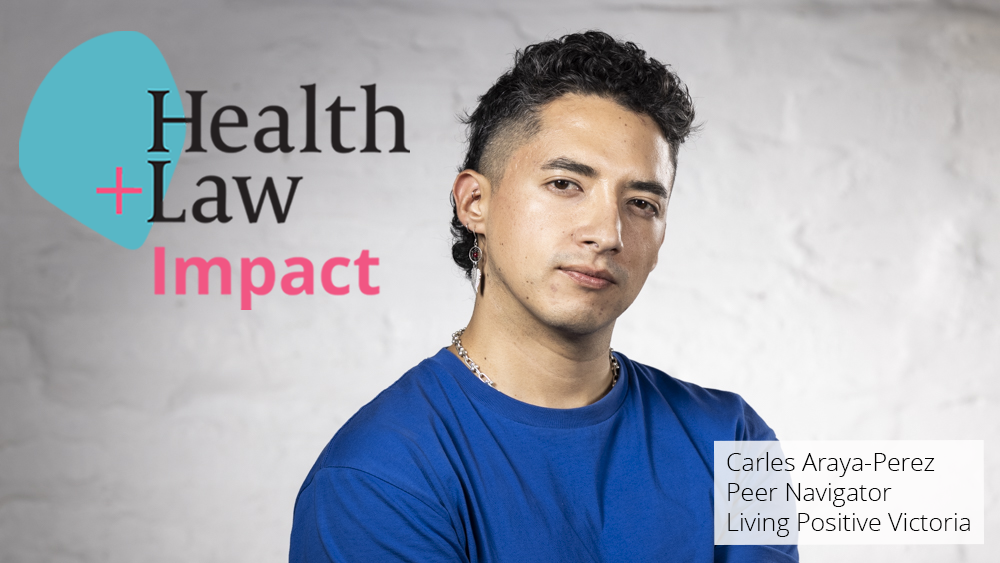
In their three years as a peer navigator, Carles Araya-Perez has been a trusted confidante to more than 100 people living with HIV.
‘And with every single one of them, I learned something new’, they say.
‘I often say I’m like a “paid friend”’, Carles says, reflecting on the work of a peer navigator. ‘I meet people one on one, we have coffee, and I share what I think is relevant. We talk about everything from sexuality, relationships, diagnosis, migration, friendships, treatment, cures, research… anything. I need to be very knowledgeable because there’s always new research coming out.’
Carles takes pride in being an important source of support.
‘It’s very rewarding, feeling like I’m supporting people, but it can be very challenging sometimes. Some people have a lot of issues when they first get referred to us, or they have never talked about their mental health, or they have all these traumatic experiences. I’m not a psychologist or a lawyer, so I’ll often have to refer them to services that are culturally safe.’
Carles’s role comes with a great deal of responsibility. Many of their clients are migrants or living in Australia on temporary visas, which can be a uniquely vulnerable experience. Migrants, visitors and other types of non-citizens in Australia are often ‘alone and lack social connections’, Carles says, and living with HIV can compound that sense of worry and isolation.
The stigma and discrimination surrounding HIV means that most people only engage with individuals or institutions they can trust, Carles says, and this limits the kinds of help available to those living with the disease. Building ‘good partnerships’ with culturally safe services is a vital part of Carles’s work.
‘People that are HIV positive, they are very anxious about other people knowing that they are,’ they explain. ‘It’s very common for people to think that all your information is connected and everyone in the government has access to that. People are often very anxious about checking HIV positive on any forms because this might compromise them.’
This anxiety can extend well beyond interactions with public and government services. Over the years, Carles has seen multiple researchers approach the HIV-affected community to study the experience of people living with HIV – and each request comes with potential risk to participants.
‘Everybody wants to study HIV in different ways’, they explain. ‘Researchers want to recruit people for their studies or interview everyone.’ In some instances, Carles says, the approach ‘can be very extractive’: ‘“I want to study you”, or “answer these questions and I’ll put you into a category or write a paper about you”. We need to protect the community from that, because they don’t want to feel like a number or a guinea pig.’
When Carles was asked to serve as a recruiter for Health+Law’s Legal Needs Study (LeNS), they felt, almost immediately, that the approach taken was different from some other research projects.
‘From the beginning I met with the [Health+Law research] team, they were very anxious about how to ask their questions, and they didn’t want to cause harm. They were aware they’re talking to people [living] with complexities. The way they talk, the terminology they use, isn’t stigmatising.’
Collaboration on developing parts of the research – like, for example, the research instruments – felt to Carles like they were mutually informative. ‘I had a lot of input into the survey. I was involved in the whole process, and that was very good because they had a positive voice as part of the whole process. When I was leaving comments […] discussing how to rephrase something, like, “some people don’t like this because it makes them think of that” they would reply “ah, I didn’t know that.” I also learned things about the law that I didn’t know before, and it helped me. So we got to learn from each other.’
The first study of its kind ever conducted in Australia – taking a ‘ground up’ perspective on the how the law impacts people living with HIV and hepatitis B – the LeNS explored how people living with blood-borne viruses encounter and experience the law in their everyday lives. Carles helped to recruit dozens of people from the HIV community to take part in the LeNS, many of whom were then referred to specialist lawyers if they had an unmet legal issue and wanted access to professional advice.
‘From the beginning it felt different to other projects I’ve been a part of,’ they reflect. ‘What was good about this project was they said, “We’re going to talk about legal stuff, this could be traumatising, but there’s support available for people if they need anything.” They had that awareness that people might be triggered, or might need mental health support after the interview, so there were services they could call or get access to.” And if there’s an unresolved legal issue, they’re going to refer you to lawyers who are going to help you.’
‘And the recruitment was done by us [peer navigators]. If someone needed to follow up on anything, or needed someone close to talk to, we were also available. So there was a lot of care in this project compared to other ones that I’ve seen.’
‘Some projects are like “I want to know all the legal issues the community face, tell us all your trauma, okay thank you, bye.” But this project said, “There’s an unresolved issue here, go talk to this lawyer and they’re going to help you”, and then the lawyers helped most of them.
‘From the beginning [when] I met with the Health+Law team, they were very anxious about not wanting to cause harm. Sometimes people have very traumatic experiences, and a lot of people get very triggered when they go to talk with lawyers. I think that’s why Health+Law asked us to recruit participants, because we could understand the anxiety or the complexity of sending someone to a strange lawyer, and we could reassure people that they can trust this project.’
Carles says it was ‘a win-win, because the community shared their experience and they got help, and the academics got to do their research.’
Much of Carles’s work involves organising regular workshops and events that create opportunities for people living with HIV to meet other members of the community. These are spaces where they can feel safe to ‘share their lived experience with the health system, their migration challenges, or anything else going on in their life.’ For many, these connections become ‘pools of knowledge’ and vital sources for sharing insights and finding answers to what can often be very unique problems that are particular to living with HIV, Carles explains, and that can feel risky to talk about outside of trusted spaces.
‘We operate in that way that we only speak with people we can trust. So we don’t have that many people that we can ask about our issues.
These groups also have their limitations. For one, members are not always willing to share their personal issues in a group setting, and don’t always have enough time or space within them to go into detail. Also, the group doesn’t always have the answers when people are grappling with complex, intersecting life challenges. ‘We all share what we know’, Carles says, ‘but it’s based on our lived experience.’
‘These [social] groups, I think, are one of the few ways that people can do that. It’s like the only support we have at the moment is the pool of knowledge… But because it is in a social setting, sometimes people don’t go into details.’
The in-study legal referrals that were part of the LeNS became one way to address these limitations. People who took part in an interview or the survey and were subsequently referred to a lawyer to talk – in detail, and in private – about their issues really benefitted from that.
‘The feedback I was getting from people was they were very happy to have that consultation with a lawyer … Many people don’t have access to that: to sit down for a one-hour interview with a lawyer, ask whatever you like, and explain the details of what is happening. One of the impacts that I saw was that a lot of people didn’t even know whether they had a legal issue or not, and they weren’t sure if HIV was related to that. People were like, “I did have this issue, but I didn’t know I could get support or get a lawyer to help me”.’
After recruiting people for the survey and then following up about their experiences, Carles saw a rising level of confidence among clients. ‘I think that gave people a lot of more confidence about what they were learning,’ Carles reflects. ‘Sixty minutes of someone asking you about most things in your life, which was 60 minutes for yourselves, instead of being in a social group.’
Carles also observed directly how identifying legal issues, and finding relevant supports, had clear and very direct impacts. It put some of their clients back in touch with the medical system, especially those who thought that by not having access to Medicare they were locked out of accessing health care altogether.
‘It really empowered people,’ Carles says. ‘If you don’t have access to Medicare there are a lot of health services you don’t have access to. But the lawyers were telling people that there are other options for you – “you can still go here, but you have to pay”. So people learned that not having Medicare didn’t mean you were out of the health system altogether. I found it very interesting, because I never thought that people would be thinking, “I don’t have Medicare, so I can’t go to the doctor”.’
Accessing some support to address complex legal needs can improve more than just a person’s connection to health care. When they followed-up with clients who had legal referrals, Carles says, there were multiple positive impacts. ‘It did have a lot of impact on people’s mental health,’ they reflect.
‘I remember there was this person that had gone to the hospital in a sudden emergency. They called an ambulance and were in the hospital for three days, and then they got this massive bill. This person is an international student so the cost should have been covered by their overseas student health coverage – the insurance that you’re forced to buy when you get a student visa to cover you for emergencies. But in the hospital, no one made the connection or asked for their insurance [details]. So this person got this massive bill, it was around $11,000, and they didn’t know what to do.
‘This person was so stressed about this debt every day, thinking, “Where am I going to get $11,000 from? Is this going to take away my visa?” They didn’t talk with anyone, and they were super stressed because of this. And [then] the lawyers fixed it [and] they were so relieved, so appreciative. Their life completely changed after that.’
In the months after the LeNS study concluded, Carles says they noticed new legal knowledge and other insights filter into the ‘pool of knowledge’ in the social groups that people living with HIV rely on for supporting one another. ‘People learn from others about all these little things that build community’, Carles reflects.
And, for their own work as a peer navigator, they say, the whole experience of contributing to the study has helped them to better support their clients.
‘As a recruiter, I learned a lot during that process. I feel more confident in my role now, and because this [study] was around legal issues, I got to learn a lot of specific things. It really boosted my knowledge around the law, and made me change the way I explain things to clients’.
Author: Michael Dulaney
https://michael-dulaney.com/