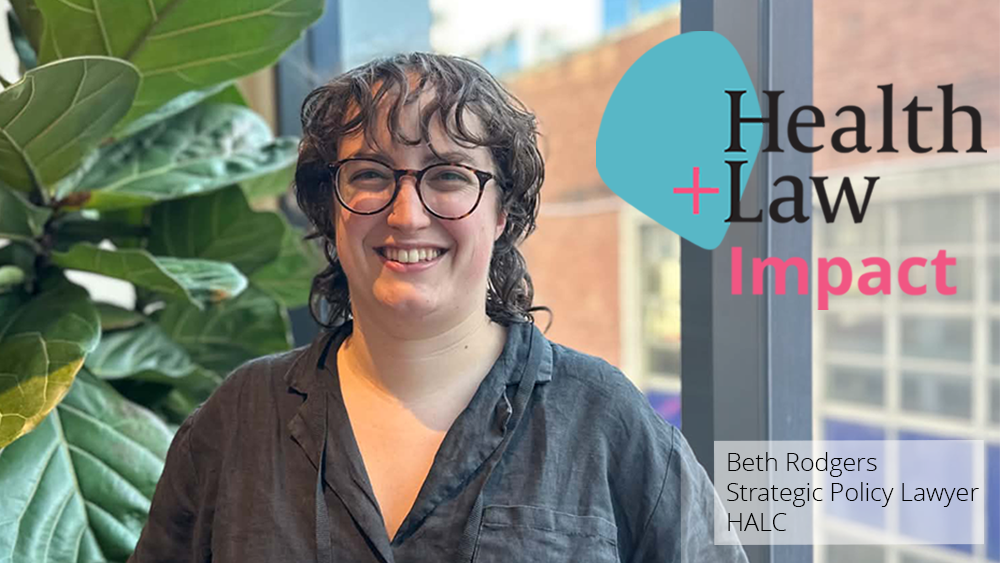
In any given week at the HIV/AIDS Legal Centre (HALC), Strategic Policy Lawyer Bethany Rodgers sees firsthand how legal barriers affect people living with hepatitis B, hepatitis C, and HIV in Australia.
‘Recently, our principal solicitor messaged me while he was on the phone to a client to ask: “Do you want to take on an insurance discrimination matter?” This was someone who had approached us about another legal problem, and separately to that has been denied income protection insurance cover because of their HIV status, which is likely going to be lawful discrimination. And we’ve had pretty good outcomes in discrimination complaints for people who have been denied insurance cover.’
Before Beth joined HALC, such an outcome may not have been possible. When she started in October 2023, the Centre employed four full-time staff members. Beth’s role, which has been funded 0.8FTE by the Health+Law research partnership, has increased HALC’s capacity noticeably. Every week, Beth sees how this benefits the Centre’s clients, who often have nowhere else to get suitable help for what can often be complex legal matters. The insurance discrimination matter is a typical example.
‘Previously, we likely would have provided advice to that client, but we may not have been able to take carriage of the matter any further than that. Sometimes, though, advice alone is not necessarily going to be as impactful as representing a client on an ongoing basis.
‘In this instance, I could say “yes” to our principal, we can help this client, whereas if this role wasn’t funded, we just would not have the capacity to take that kind of work on – particularly during periods where the Centre is really busy.’
I would say several times a week for the past couple of years, I’ve seen examples similar to that. Many of those opportunities relate to legal advocacy, policy work and projects’
With Beth able to focus on policy and advocacy work for the past two years, HALC has been able to take on a greater role in advocacy and law reform activity in areas relating to HIV and hepatitis.
‘Without Health+Law we wouldn’t have had the funding for this role at all, and as a result, our capacity to do lots of different types of work has been increased,’ Beth says. ‘I’ve been able to contribute to policy and law reform in conversations where, if this role wasn’t funded, we just would have had to say “no” or contribute on a very limited basis, whereas we’ve been able to say “yes” and take the lead more often. This has included taking the lead writing guides to increase health and law literacy.
‘It’s helpful to have a distinct role focusing on policy work at a community legal service, because then you don’t have to choose between helping a client or being involved in more systemic work. At the end of the day, you’re always going to choose to help the client.’
Collaboration between the Centre and the research partnership has also transformed HALC’s services. In 2024, Beth co-led one of Health+Law’s major activities: an impact evaluation of HALC’s work since the 2019-20 financial year. This used a broad range of sources to assess the extent to which HALC achieves its core missions, including improving the health and lives of its clients, and the systems and organisations that support them.
’We were able to evaluate our services in a meaningful way for the first time ever outside of the ways we’re obliged to as part of our annual reporting,’ Beth says. ‘We hadn’t looked at our outcomes on that kind of panoramic, systemic level to think about our rates of success, or whether we were able to point to trends over a long period.’
‘The evaluation analysed all of our existing data over the past five years that hadn’t been looked at in-depth before, and we also collected additional data, including interviews with stakeholders and some recent clients. Using that material, we could then show, for example, trends of more people seeking our services. We’d expanded to Queensland in that time, and the evaluation showed that there was clear demand for the service in the places we expanded to, and the model of that expansion, collaborating with local HIV support service, Queensland Positive People, was well-received.’
‘And then, similarly, the evaluation looked at all the law reform and policy work we did over five years. We were able to gather feedback on how we can improve our services and also the role we have in advocacy. Pointing to how, for example, there’s not many lawyers familiar with the HIV and hepatitis space – people in the blood-borne virus sector and community spoke about how that’s really helpful in being able to support community health organisations with advocacy and various campaigns.’
Much of this came together with Health+Law’s flagship project, the Legal Needs Study (LeNS), a national study involving 141 in-depth interviews and over 1000 surveys of people living with hepatitis B and HIV about their legal experiences. The first study of its kind in Australia, LeNS comprehensively explores how people living with hepatitis B and HIV experience the law in their everyday lives – and it also introduced dozens of people to HALC for legal help they may not have otherwise been able to access, Beth says.
‘With the LeNS survey and interviews, participants were referred to us for help if they had a current legal issue,’ she explains. ‘We help a huge proportion of people with HIV in New South Wales, but lots of those survey participants were in other states and territories, for example, and others were new to Australia. Some of those people didn’t know we existed.’
‘Through the LeNS, people were able to get help they might not have otherwise been eligible for or known was possible. Often, the legal issues things people are coming to us for are quite significant and complex. And that was the case with many of those referrals that were coming in via the LeNS. So it’s great that there was an intervention available.’
‘Health+Law’s research has also increased our potential to be successful when applying for grants and funding in the future. A few times recently we’ve been writing grants and have been able to lean on statistics from the national Legal Needs Study (LeNS) as well as findings from our evaluation, which increases the legitimacy of those stories. Working within HALC you often see the impact we have firsthand, but we’re not always able to tell that story easily, especially to people that don’t have a clear understanding of the significant legal needs people have when they come to us. Funders, for example, may mistakenly perceive HIV and hepatitis-related legal need as a ‘niche’ problem affecting a small amount of people.’
Beth believes that the LeNS results have been, and will continue to be, instrumental in supporting HALC’s services into the future. Historically, the Centre has long been among the lowest funded community legal centres in New South Wales; however, it was recently successful in securing uplift funding under the National Access to Justice Partnership (NAJP) through a highly competitive tender process. This represents the first substantive funding increase the Centre has received in many years and will provide it with greater stability over the next four years.
‘Health+Law’s research was a huge asset in our request. We were able to demonstrate not just the scale of the legal need of people living with HIV and hepatitis in New South Wales, but also the impact of these legal issues, their interconnectedness with health problems, and the distinct barriers to accessing justice that people in these communities experience.
Working with academics at UNSW’s Faculty of Law & Justice, UTS Law, and QUT as part of the research partnership has added a new perspective to the legal expertise within HALC, Beth says.
‘They [academic legal researchers] all have a different lens to put on things that lawyers may not always think of,’ she explains. ‘Say, for example, we’re looking towards applying for a grant, they’re able to say, “All right, what’s our intervention? What are the priorities, and why are they the priorities? How are we going to measure the outcomes?” We’re lawyers working in a space that has lots of health impacts and crossovers into health care, but we often aren’t able to tap into funding from research or health sources without that kind of help understanding the evidence base and the broader-reaching impacts of our legal work.’
For example, HALC has collaborated on (and utilised) research led by Health+Law into the perspectives of the Australian sexual health and blood borne virus workforce on legal issues affecting people with blood borne viruses, showing clinicians often view unmet legal needs as severely impacting health. As well as research into people living with HIV using sub-optimal HIV treatment in the belief it will assist their migration case.
Beth thinks the expanded capacity at HALC has benefited the sector as a whole. ‘If you just take the example of writing submissions to parliamentary inquiries, often we are well suited to do that because we understand the legal aspects quite well, whereas other organisations understand the impact on the community better. And so, it’s good to be able to take on that work and write submissions that get to the legal questions as well as involve community perspectives.’
Beth has also used findings from the LeNS to support her law reform work. ‘Recently, we contributed to a reference group about coercive control in New South Wales, which was criminalised recently. The stats from the LeNS survey were useful in showing the rates of coercive control and other forms of family and domestic violence that people with blood-borne viruses experience.’
‘For example, the law only applies to intimate partner relationships, whereas sometimes the forms of coercive control that people are experiencing might be threats to disclose their HIV status from non-intimate partner relationships, like a friend or a neighbour. And it can be more powerful to point that out to the government in the form of statistics, and not just case studies. It helps us to show that there may be more policy changes needed to address coercive control in all its manifestations.’
Beyond its impact on HALC and the Centre’s law reform work, Beth’s almost three years in the Health+Law-funded role has influenced the direction of her career. ‘From quite early on in my studies, or even just my life, I was interested in work that had a positive impact,’ she says. ‘When I started university, it was questions about what the law should be – rather than what the law is, the black and white application of the law – that were most interesting and most impactful in my eyes.
‘After uni, I wasn’t set on being a practicing lawyer. Even though I would have been admitted, I may not have done any client-facing work. But it didn’t take long after being at HALC to change my mind.’
Beth was admitted to the Supreme Court of New South Wales as a solicitor while working at the Centre.
‘This is a bit of a common pattern of experience that we see at among practical legal training students that come to HALC. Law can be very complex and dry at points, but for some emerging lawyers it becomes much less boring when you see there are clear, real-world impacts for clients. The support and expertise that an environment like HALC can offer becomes really important when it’s clear that a person has a legal issue that a blood-borne virus specialist service is best-placed to assist with – where it would be hard to find that specific knowledge and service elsewhere’
Through her time with Health+Law, the direction of Beth’s career has changed, and the sector has also gained a dedicated, capable solicitor. In the past year, Beth says, her skills as a lawyer and abilities in stakeholder engagement work have grown, and she has noticed how the links she has worked to establish between HALC and other community organisations have started to yield results.
‘In the past year I’ve become more familiar – and been able to collaborate better – with people in the sector,’ she reflects. ‘You meet people and do joint projects, and you get to know people through the process. I get more emails from other organisations asking me to do things now, and I realise, “Ah, it’s because I said yes last time.”