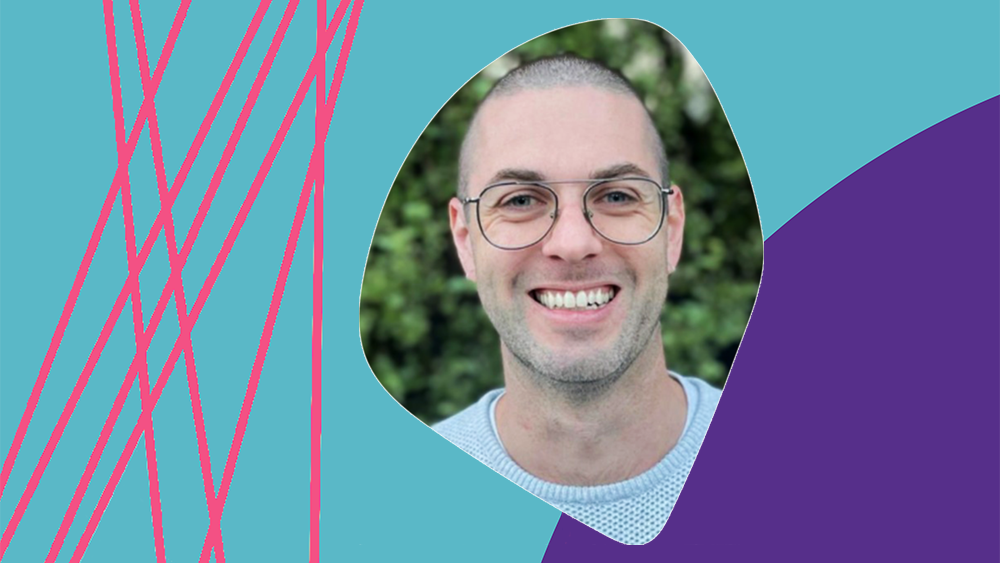
Health+Law Team Member Interview: Daniel Storer
Health+Law’s mission requires more than legal expertise alone. It requires people who can move between the broader evidence base – to understand what’s happening to people affected by HIV and hepatitis B – and the legal and policy mechanisms that produce those outcomes.
Daniel Storer is a member of the team who brings these capabilities together to understand how law produces health effects for people living with a blood-borne virus in Australia. He brings valuable insights into policy, community partnerships and collaborative projects from several years’ work in the HIV sector, and he honed his qualitative social research skills with a PhD in the School of Population Health at UNSW.
In 2025, Daniel moved from the role of Research Assistant to an appointment as a Research Associate in the Health+Law partnership. This summer, we talked to Daniel about his PhD research on how COVID-19 affected the sexual cultures of gay and bisexual men in Australia, his work experience in the HIV sector, and his role at Health+Law.
Daniel, could you tell us a little about the thesis you recently completed?
The focus of my PhD was on the impacts of COVID-19 on the sexual cultures of gay and bisexual men in Australia.
The way people approach sex and the meanings they ascribe to it are not simple, stable or unchanging things. Sexual culture is always in flux. The sexual cultures of gay and bisexual men in particular have sustained some really major changes, especially since the upheavals of the AIDS crisis in the 1980s, and then the multiple waves of social and medical advances that emerged around HIV testing, treatment and prevention since then. These kinds of public health – and other – developments can have huge impacts on how people think about and conduct their sex lives.
Although not an event specifically connected to HIV, COVID-19 affected everything. It presented a vastly changed context, including stay-at-home orders, in which gay and bisexual men (and everyone else!) were compelled to alter their social and sexual behaviour.
What were the project’s central lines of research inquiry, and how did you go about addressing them?
I wanted to investigate these alterations, and to find out how cultures of sex were impacted during 2020 and 2021 of the COVID years. Within this broader inquiry, I devised three core questions. The first was about emotion. Much of the research I encountered when I was starting out my PhD was concerned with how gay and bisexual men were navigating sex and the risk of acquiring COVID-19. The main finding seemed to be that most men were pausing sex, or if they did have sex, were altering their practices to reduce the risk of COVID-19 transmission. Building on this, my first research question was about the role that emotions played in this new context: how did gay and bisexual men feel about these new conditions of sexual risk?
The second question was about antiretrovirals. At that time, there was scientific curiosity – which led to studies and speculation in queer media and other circles – about the potential effectiveness of antiretrovirals used to treat and prevent HIV as a way to also prevent and/or possibly treat COVID-19. Given the existing culture of antiretroviral use, including PrEP (pre-exposure prophylaxis, for the prevention of HIV transmission), I wanted to understand how gay and bisexual men themselves were speculating about the potential of these drugs, and whether this led to any changes in their drug use habits.
Third was a question about changes in use of digital hook-up apps in the context of restrictions to in-person socialising. While most other research considered changes in how much people used hook-up apps (more, less, or the same amount) and whether they shifted to socialising on them rather than using them to arrange meet ups, I wanted to understand the interactions people were having online. As a major space of social and sexual interaction for gay and bisexual men, they play a big role in their social and sexual lives.
To do this all of this, I recruited participants from an established project called the Flux Study, which is about the health and sexual behaviours of gay and bisexual men in Australia. I interviewed 30 participants in August–November 2020 and most of them again in June–October 2021. The interviews explored sexual behaviour, HIV and COVID-19 prevention, online sociality, and attitudes to both public health orders and COVID-19 vaccination.
Can you tell us a bit about your earlier work in the HIV community sector? How did that prepare you for research on the lived experience of people living with blood-borne viruses?
I started in the HIV community sector back in 2017, working at the Australian Federation of AIDS Organisations (now Health Equity Matters), which is the national federation for Australia’s leading HIV and LGBTIQA+ organisations. My work there really varied, including everything from creating policy documents in response to government inquiries, to working with the federal government to improve the country’s HIV response, to working with state and territory member organisations on advocacy campaigns in their own jurisdictions.
I had the chance to work with pharmaceutical companies and the Pharmaceutical Benefits Advisory Committee on ensuring that PrEP was funded under Australia’s pharmaceutical benefits scheme. I helped plan and deliver the annual World AIDS Day parliamentary breakfast (more than once!), bringing MPs from across the political spectrum and both houses of parliament together to demonstrate multipartisan support for the HIV response. I supported community organisations, like SWOP, a peer-based health promotion service for sex workers in the Northern Territory, who were making a submission to a government inquiry into the decriminalisation of sex work in the Territory.
This broad range of people, organisations, processes and issues has, as a researcher, given me quite a practical outlook. I have insight into what various sectors, organisations and stakeholders want, which can be really helpful when the work is social research aimed at improving services, policy, law and systems reforms. And seeing those real-world applications for research has strengthened my drive to contribute to that knowledge base.
You’ve also worked as a Research Officer at the Kirby Institute and the Centre for Social Research in Health (CSRH) on qualitative, interview-based studies and online quantitative research. What did you do in those roles?
I’ve been fortunate to work with some amazing people on some great projects at the Kirby and the CSRH at UNSW, and also with other colleagues at UNSW. There have many projects, so brace yourself!
At the Kirby, I worked on the Flux Study, as I mentioned before, which has been running since 2014. Flux was first concerned with trends in drug use and mental health, then moved to more of a concentration on biomedical HIV prevention. When I joined the project, COVID-19 had created a new world for everyone to navigate, and people were concerned about its impacts. As part of the move to capturing experiences of COVID-19, a qualitative interview project was added to the study, and that formed the basis for my PhD.
Also at the Kirby, I had a role on the M3THOD Study, which investigated and evaluated peer-led interventions for (cis and trans) gay and bisexual men, trans women and non-binary people who practice sexualised drug use, or ‘chemsex’.
Another project was on COVID-19 vaccine acceptability in priority populations, which brought together four qualitative interview projects conducted during 2020 among HIV and STI priority populations: interviews with Aboriginal people, people who inject drugs, people living with HIV, and gay and bisexual men – all groups with histories (and present day experiences) of discrimination in health care. We focused on how these populations approached COVID-19 vaccination given these experiences of discrimination.
At CSRH I worked on two fascinating projects: one on Mpox, and one on HIV and the sexual health of MSM, including men who identify as heterosexual/straight, bi+ and gay.
And finally, Daniel, what are you working on at the moment at Health+Law? And what makes you most excited about it?
At the moment, I’m leading a project on documenting, measuring and reporting the impact of Health+Law’s activities. This is about looking at what we’ve done, how effective it has been, who it’s been effective for, and how we can measure this impact in the future.
Much of the work that we do, and the impact that the partnership has, is outside of the boundaries of traditional academic work. And so, trying to capture this requires us – and me – to think creatively about how we can make this impact measurable and interpretable within those traditional academic models. I find that part of the work exciting.
I’m also super grateful to be able to honour the experiences of people living with HIV and hepatitis B who play such a huge role as research participants, and in so many other, various ways, offering their expertise, leadership and reflections. This is the essence of the work, and it really is a privilege to be able to work with the personal experiences that people have shared.
Explore more of Daniel’s work:
An article in the Sociology of Health Illness from Daniel’s PhD on gay and bisexual men’s understandings of HIV antiretrovirals during COVID-19.
Daniel in conversation with community radio station 3CR about findings from the Flux Study
An article in Culture, Health & Sexuality about the experiences of people diagnosed with Mpox and their and close contacts during the 2022 outbreak in Australia
Daniel’s Google Scholar page