When Patients Have Legal Issues: Introducing Two Groundbreaking New Tools for Healthcare Workers

People are far more likely to see a healthcare worker than a lawyer. Community nurses, GPs and other kinds of professionals in the primary healthcare workforce are also often a trusted, familiar or regular point of contact, offering people a place where they feel safe to raise problems, including – potentially – legal ones. This places healthcare workers in a unique position to recognise when a problem may have a legal dimension, and to guide their patients toward information or support.
‘For many clinicians, this can feel tricky. ‘Legal issues’ come in many forms, including across areas such as housing insecurity, debt, family violence, discrimination, unsafe working conditions, migration challenges – the list goes on. All of these can affect a person’s health and wellbeing, sometimes in obvious ways and other times more covertly. The very fact of a problem having a ‘legal’ side to it can, in itself, be hard to come to grips with.
And yet, we know that law shapes health outcomes. Just as housing, income and education are often described as ‘social determinants’ of health, law and the legal environment can play a powerful role in shaping whether people access healthcare, and the safety and quality of their experiences when they do. For people living with blood-borne viruses such as HIV, hepatitis B and hepatitis C, the legal determinants of health have a specific valency. While everyday legal problems are a commonplace part of life for all people across the community, Health+Law’s research shows that people living with blood-borne viruses in Australia experience legal issues at significantly higher rates. They commonly experience multiple legal issues at the same time, and a majority report that their most serious legal issues are linked to, or worsened by, living with a blood-borne virus.
Healthcare workers consistently report encountering these issues in their practice. In a national survey of the Australian sexual health and blood-borne virus workforce conducted in 2023, we found that:
87% of clinicians recalled patients living with blood-borne viruses who had experienced a legal problem
76% had been directly approached for help with a legal issue
52% said they would like to make more legal referrals, and
None said they felt very confident screening for legal problems.
To strengthen that confidence and capacity, Health+Law and ASHM Health – with the input and advice of other community members and partners – have now developed two practical new tools for the blood-borne virus healthcare workforce. These tools are aimed at GPs, nurses, midwives, hospital-based physicians and support staff, dentists, allied health professionals, specialised practitioners like paramedics, Aboriginal health workers, and more. Anyone who might encounter and support a person living with a blood-borne virus might have an opportunity to do more.
An Australian-first Online Learning Module Teaching Practical Legal Skills
Co-created with ASHM Health and hosted in their extensive education library of free online training courses on HIV, blood-borne viruses and sexual and reproductive health, is our new legal module for healthcare workers. The Supporting patients with legal issues: Practical skills for the BBV healthcare workforce e-Learning is designed to build confidence, knowledge and practical capability.
Importantly, this training doesn’t aim to turn healthcare workers into legal experts. Rather, it equips people in the workforce with the basic knowledge and essential, practical skills to identify legal problems early and respond safely and ethically within their professional scope.
Available online here, the module has been designed and developed to healthcare workers to:
Recognise common legal issues affecting people living with blood-borne viruses
Clarify the boundaries between providing health information, advocacy and legal advice
Understand the relationship between everyday legal problems and health outcomes
Use appropriate and supportive communication strategies to discuss legal concerns
Conduct a focused legal needs screen during routine consultations, and
Initiate appropriate referrals where needed, and support their follow up.
Drawing on the latest research across legal and public health fields, including findings from our national legal needs study (LeNS), Health+Law developed this new training with input from community partners, and under the leadership of research team members Rhys Evans and Louisa Luong, with oversight and input from Associate Professor David Carter, Katrina Mathieson, Cara Bruce and Dr Dion Kagan.
The course takes approximately 70 minutes to complete and has been approved as a continuing professional development (CPD) activity by the Royal Australian College of General Practitioners (RACGP) for the 2026–2028 triennium. Endorsement from ACRRM is pending. Hepatitis B s100 Prescribers can accrue one Prescriber Point upon completion of the training.
A Simple, Powerful New Screening Tool for Patient’s and Client’s Everyday Legal Issues
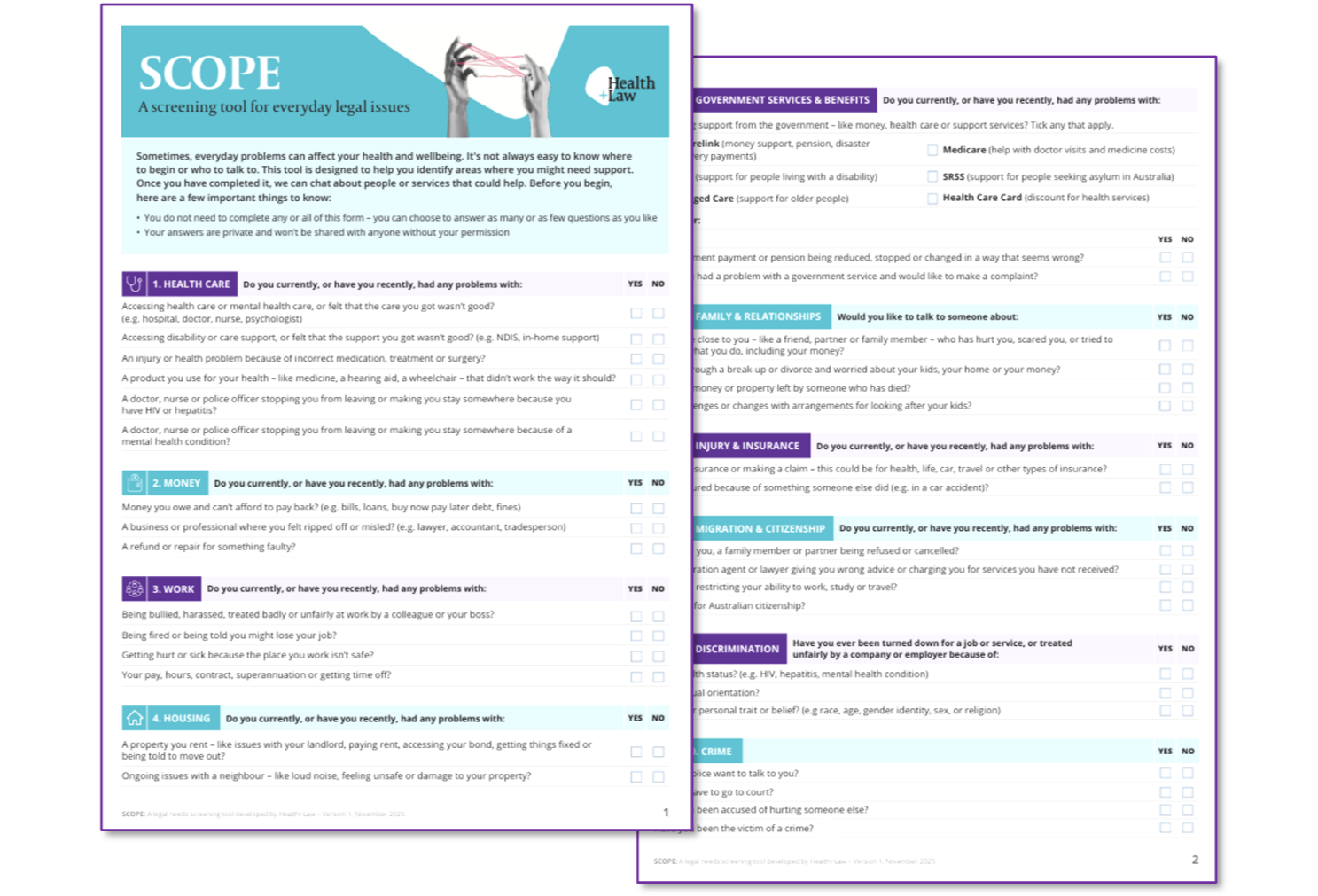
Alongside the e-Learning module, Health+Law has developed SCOPE – a screening tool for everyday legal issues.
Screening tools are generally brief questionnaires or checklists that patients can complete independently, with a practitioner or service provider, or that can simply be used as a basis to spark a conversation. They tend to be brief, and rather than producing a ‘definitive diagnosis’, they help to identify red flags that someone might be at risk of, or experiencing, particular problems that require further attention.
Legal needs screening tools are a simple resource to help all kinds of workers to identify unrecognised or unmet legal need and support early referral. They can be used across health and community sectors, in multiple types of settings, and by all kinds of practitioners – not just healthcare workers.
A handful of such tools have already emerged across Australia, and are in use in other parts of the world. We developed SCOPE specifically in response to workforce survey findings and evidence from our national legal needs study (LeNS), which both showed that clinicians frequently encounter people’s legal problems but often lack both the confidence and structured ways to identify and respond to them. Our research also demonstrated support for a screening tool specifically designed to address the needs of people living with blood-borne viruses and the workforce that supports them.
Drawing on current research and a process of sector consultation, SCOPE was designed to be practical, clear and suitable for use within routine services and care settings. It supports a broad range of workers to ask focused questions, to be completed independently by patients and clients, or just as a set of prompts to help spark a conversation. SCOPE has been designed to recognise common legal issues, and connect people with appropriate legal and community services.
Importantly, SCOPE is not a diagnostic instrument and nor does it require legal expertise. It is a structured guide – a way to initiate important conversations and to identify when more information or a legal or other type of referral may be helpful.
SCOPE is available here.
Why We Need These Tools
Legal problems can undermine health outcomes, and this matters. A person’s legal burden can increase stress, interrupt treatment, destabilise housing or employment, or exacerbate experiences of stigma and discrimination. Critically, when legal issues go unrecognised and unaddressed, they can limit the effectiveness of clinical care.
On the other hand, early identification and referral can strengthen continuity of care and significantly improve wellbeing and people’s health outcomes. Together, these two new tools offer:
Evidence-informed training
A practical screening framework
Clear referral pathways, and
A shared language for legal-health literacy within the blood-borne virus workforce.
Listening for legal issues does not mean stepping outside the scope of clinical practice. It means recognising the broader context in which a person’s health is experienced – noticing that, and responding in ways that are safe, structured and person-centred. When you take the time to understand a legal problem and you have the right tools, you can make a meaningful difference.
Key Links
ACCESS the ‘Supporting patients with legal issues’ e-Learning module
VIEW and DOWNLOAD SCOPE for your workplace or practice
SUBSCRIBE to Health+Law’s occasional newsletter to hear more, and to attend our forthcoming webinar on these tools